The First Journey of Amos Cutter
Copyright © 2026 H. Jonas Rhynedahll. All rights reserved. This excerpt may not be reproduced or distributed without permission.

"When I was young," Amos's Dad said, "there was a spell for this."
Amos straightened, using his legs to raise the cart axle from the big oaken blocks to meet the repaired wheel that his Dad held ready.
"Sure, Dad," he said. "When you were young, they had spells for everything."
"I'm not kidding!" Amos's Dad exclaimed as he wrestled the big wooden wheel with its hand-forged iron tyre towards the bare axle nub. The wheel was two-thirds of his own height, and it had taken the two of them almost a week to break the old wheel down, use draw knives to cut blanks into replacement spokes, and reheat and shrink the tyre onto the wheel.
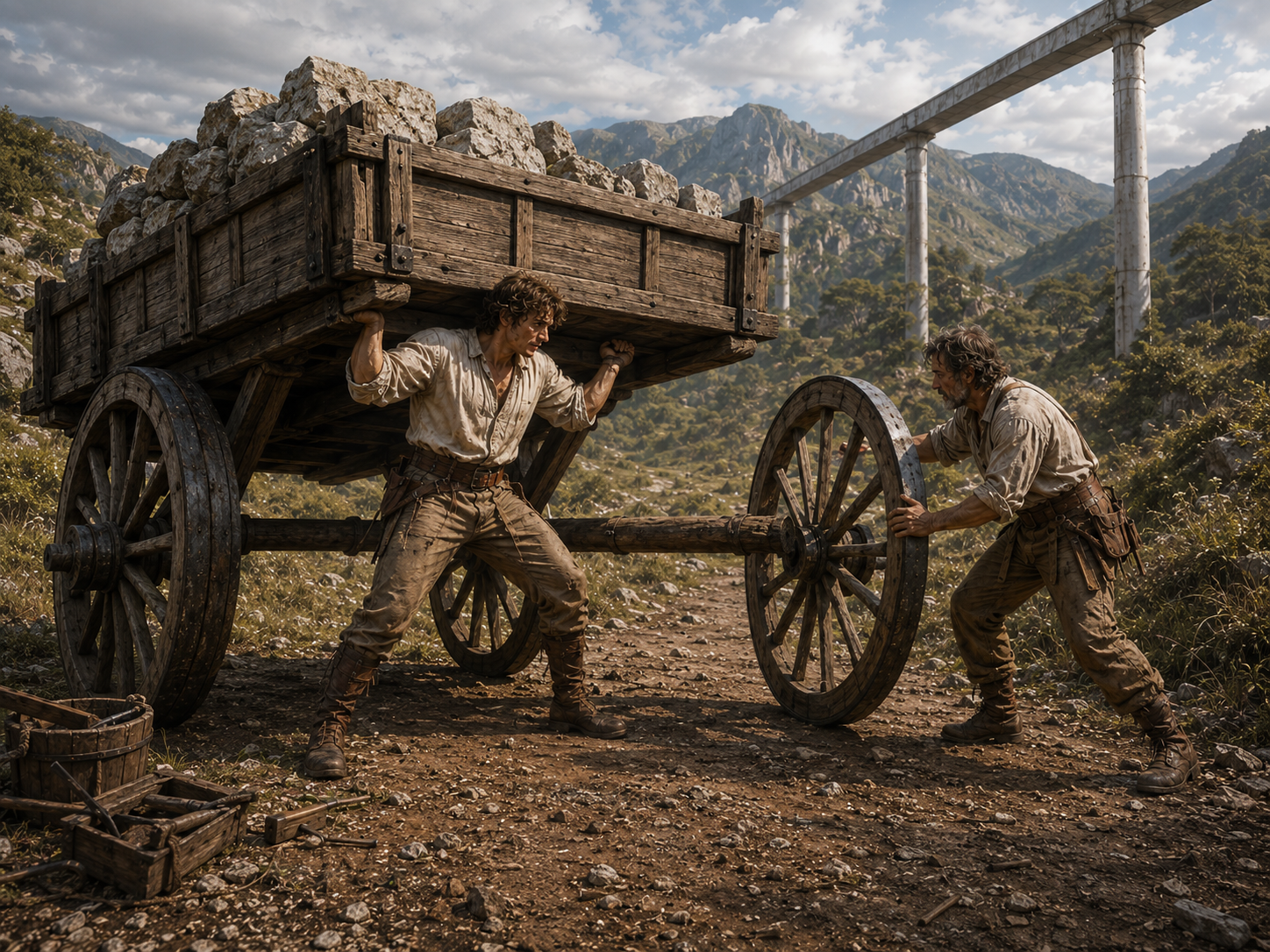
"You could get a spell to fix a tyre on a car at the hardware store for a credit and a half."
“I know, Dad. You’ve told me. They had a spell to wash the car too. Cars had magic suspension that made it seem like you were riding on air.”
Amos let the weight of the cart settle onto the wheel as his Dad spun up the locking nut. "You told me that last month when we changed the wheel on the manure cart and about a hundred times before that."
Amos's Dad shook his head. "Couldn't have been. You haven't been big enough to help me change wheels but for maybe the last five or ten years, and in that time we've only had to change a wheel on one of the carts maybe ten or twenty times."
"Sure, Dad."
“In our first three years here in the valley,” Amos's Dad continued, “I was operating from misremembered descriptions from a book I had read maybe once. I had to learn by trial and error how to forge salvaged iron, how to shape white oak to form felloes and spokes and hubs, and how to build an axle that would not break the first time it was put under load.”
“I know, Dad.”
“There wasn’t anything else to do,” Amos's Dad emphasized. “Our handcomms didn’t work and the video screens in the carriage were dead. I used to read everything on my handcomm. School assignments, novels, the works! But that night it was all gone. All the things that I had used to entertain myself for the first seventeen years of my life were taken away at the snap of a finger. When magic died, it was the end of the world that I had known.”
“Sure, Dad. Sure.”
Amos's Dad finished tightening the big square nut, inserted the keeper pin, and then took a step back and began wiping grease from his hands with a rag. "Let's go ahead and dump this load. We’ve got enough time before supper and we’re already behind on this project."
Amos nodded, pulled the oak jack blocks from underneath and tossed them onto the top of the load, then walked around to the front of the cart to pick up the tongue with one hand. He gave it a tentative tug to draw the cart along a few feet. Nothing seemed amiss, so he turned about and started off at a brisk walk, with the heavily loaded, ten-foot-long cart coming along easily behind him.
This was their biggest cart by four times. When Amos's Traits had shown themselves, his Dad had started on a new cart to take advantage of them.
The stream where they were building a dam for a fish pond was just a little more than three miles from the house, but the cut through the ridge where they were harvesting the stone was almost six miles back along the monorail line. The wheel had broken under a full load of stone a little more than halfway along the route.
Amos's Dad scurried to catch up. Amos was head and shoulders taller than his Dad, and a lot of that was in stride.
“Don’t tire yourself out," Amos's Dad told him. “Rest when you want to.”
"I'm good, Dad."
"You don't really get tired any more, do you son?"
"Not much, Dad."
"I think that's another Trait, coming through."
Amos shrugged. "Could be, I guess."
Amos's Dad sighed. "If the world hadn't ended, the provincial government would have shipped you off to some research facility on the other side of the world or one of those islands that nobody was supposed to talk about, so I'm glad it did."
"Mom says that if the world hadn't ended, all of us kids wouldn't exist," Amos pointed out, "so it wouldn't have been a problem."
Amos's Dad laughed. "That's true, son. She went to a school on the other side of the province and was a year and a half older and two levels ahead of me. If we hadn't been stranded out here together, she wouldn't have given me half a credit's worth of bother."
Amos knew the story by heart; both his parents had told it to him for his entire life.
"Sure, Dad. You've told me that a hundred times."
"More like two hundred. Pick up the pace a bit, son. I'm getting a little hungry."
The hard-sided, four-wheeled cart was not made to dump, so they unloaded the head-sized quarried stones by hand. Amos hurled his from the back of the cart across the fifteen paces of the sloping creek bank to the dyke that they were constructing in the channel. His Dad carried the stones one at a time, stopping often to wipe his forehead with a handkerchief.
One of the times, his Dad said, “When I was young they would have used GIP to build this dam. One spell and it would have been done in half a day.”
“Yes, Dad. Grown In Place. A stone-like material that was waterproof, flexible, and stronger than steel. Even if we had that spell, Dad, we wouldn’t be able to build the dam with it because we don’t have steel forms to contain the GIP until it finishes growing.”
His Dad put his handkerchief away. “I guess you’re right son. Sometimes I wish your memory wasn’t so good.”
Amos nodded and increased his pace.
Even so, the unloading took longer than expected and the sun was nearly down to the top of the western mountain ridge that formed that end of the valley by the time Amos had hurled the last stone.
Amos's Dad grimaced. “We’ll be late. Your Mom and I are going to have words again.”
“Get in the back of the cart, Dad. I’ll run. We’ll make it in plenty of time.”
“The last time you nearly bounced me out.”
“Hang on tighter.”
“Alright. I guess a few bruises are better than setting off your Mom.”
As soon as his Dad had taken a seat in the bed, had braced his feet against the front, and had taken a firm grip on the right sideboard, Amos took off. The cart track that paralleled the monorail line was just two lines worn down into the rocky red earth through the high grass of the right-of-way, and was a bad surface for running, but he managed the irregular footing easily. He did not sprint the entire three miles, but slowed to a trot when they came within sight of the house. His Mom tended to scold him if he showed his Traits too plainly in the open. When she had been a little girl, one of her neighbors had shown his Traits by saving people from a house fire. That man had been picked up in a black van one day and never seen again.
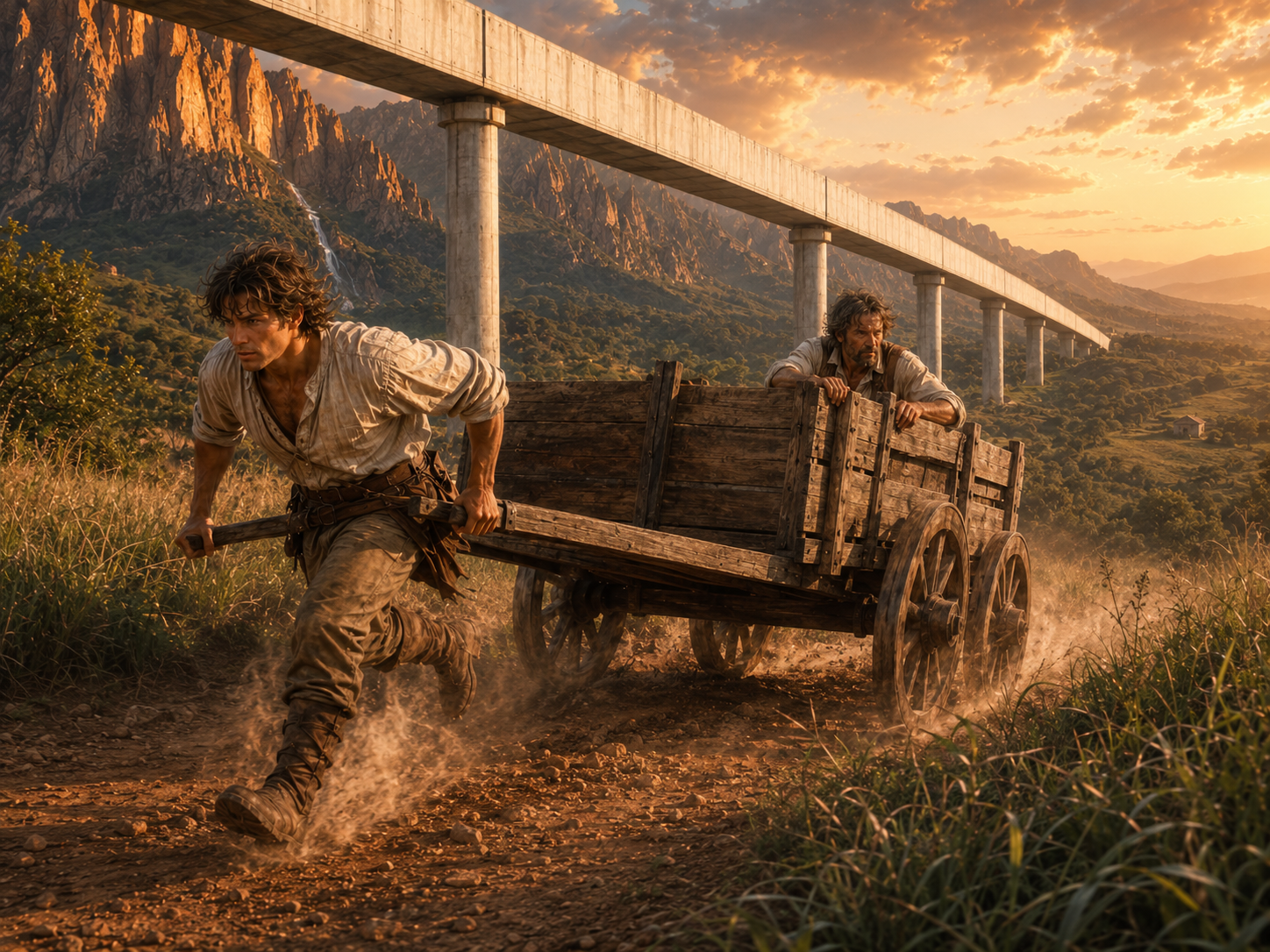
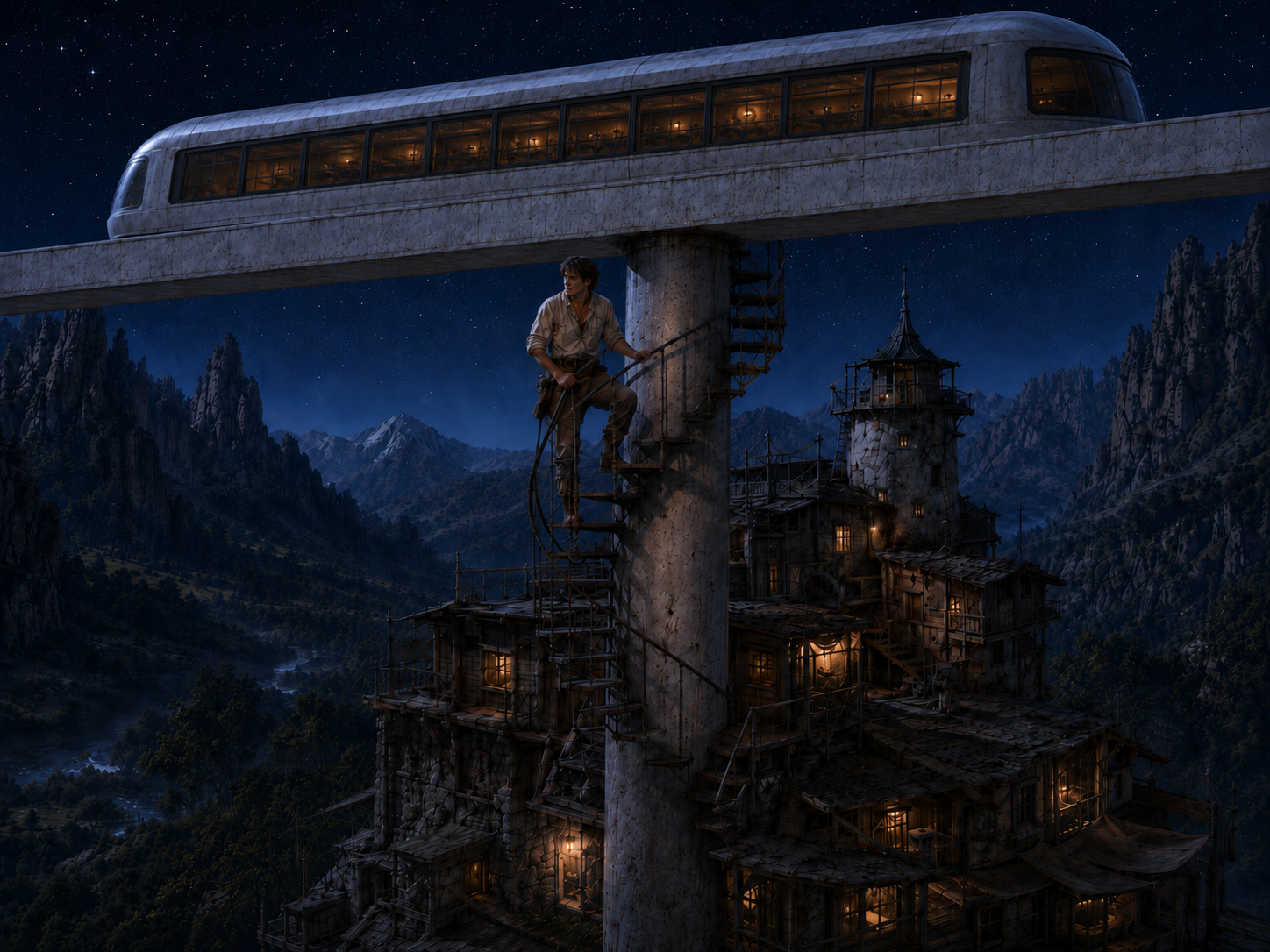
Amos had never seen a van, but knew from his parents that it was a type of car, and that a car was a wheeled vehicle with a metal skin and “vulcanized rubber tyres filled with air” that was given motion by a complex Third Order spell. His mental picture of the vehicle resolved by default to the single available example of a machine, the stalled monorail carriage atop the elevated monorail at the center of the valley. The carriage was sleek, metallic and shiny, and rounded on both ends for “two-way travel” with a band of dusky glass windows all along its length.
The carriage had brought his parents to the valley and stranded them there when the world ended.
Now, it was just his room.
Their house was a rambling structure built of hand-hewn wood, limestone-ash plaster, and some dry stonework in the foundations, and had split-wood shingle roofs that leaked and had to be repaired every season. Every time the family had expanded, the house had expanded, and it was a hodgepodge of design and expediency, with balconies and exterior stairways connecting rooms and floors wherever Mom had decided that such a connection be made. Mom and Dad had meshed most cleanly when she was, one, pregnant, and two, telling Dad where she wanted him to add a room. Everything was a naturally-weathered color, gray or bleached brown. “Paint” was “a liquid covering that protected material from the elements,” but neither Amos's Dad nor Mom had ever tried to learn to make any. Most of the house was a single storey, spread out in a haphazard way, but the Tower, which was the older girls’ exclusive domain, went up a full three stories.
The rounded white tower of the support pylon for the monorail rose up out of the center of the house as its main support and central backbone. The original metal stairway spiraling around the pylon was the central stairway of the house.
Mom was waiting on the front porch, with her hands in the pockets of her long apron. That was a bad sign. If her hands were not moving, gesturing, pointing, slashing the air to make a point, she had moved beyond regular mad into dangerous territory.
Amos's parents were not technically at war, as they had declared a ceasefire some eighteen years ago, but every now and then, as Dad said, “they fired salvos at each other to make sure their guns still worked.”
They shared the same room, and the same bed, and occasionally showed affection for one another, but they really did not get along at all.
Amos stopped the cart, dropped the tongue, and while his Dad climbed laboriously down, Amos ran up to the steps of the porch. “Sorry, Mom. We’re late because I had to stop to rest. I was tired and got dizzy.”
Amos's Mom’s expression changed in an instant. She brought her hands out of her apron and beckoned him urgently. He climbed the steps and dropped to one knee so she could reach his forehead; his Mom was a head shorter than his Dad.
His Mom laid the inside of her wrist on his forehead to take his temperature. “Is your heart beating too fast? Are there any other symptoms?”
“No, Mom. I was dizzy for just a few minutes.”
That was a lie. Amos had not been dizzy since he first displayed his Traits at the age of three. That was also about the time that he had learned to deflect his Mom’s anger and general tendency to react abrasively to every situation and unacceptable event by lying about the “negative side effects” of his Traits.
Amos's Dad and all of his brothers and sisters knew that he lied, which was not an excuse, but simply the reality that peace, at whatever cost, was preferable to truth, at least in Mom’s case.
“You don’t feel warm to me. Wash up and come to the table. We’re putting out the food.” Amos's Mom turned to Amos's Dad. “Mister Cutter. Don’t track those muddy boots across my clean floors. Don’t dawdle.”
Amos's Dad waved a hand. “Yes, Miss Amos! I’ll be right in, minus the boots.”
Amos's parents had never been married and his Mom had insisted on the survival of her family name. Amos did not mind; Amos Cutter had always sounded right to him.
In the valley, it did not really matter that all of his siblings only had a given name.
Amos's Dad sat on the edge of the porch and began to remove his boots. The boots were deerhide and the left was bigger than the right. Both were somewhat misshapen. Dad had tanned the leather and Mom had sewn them and neither was particularly good at either skill.
“You know, Amos, one of these days that’s going to stop working.”
Amos smiled. “Yes, Dad. But that day isn’t today.”
Amos's Dad just shook his head.
After he crossed the porch, Amos had to duck as he went through the front door; this was the oldest part of the house and his Dad had not anticipated having a son quite so tall at that point. The interior layout, by necessity, followed the curve of the pylon, so the ground floor main hallway followed an oblong path around to the dining room in the back. Mom’s rule was clockwise. One time when Amos had been fifteen, his parents had actually slept in different rooms on opposite sides of the house for eight and a half months because his Dad had gone counterclockwise to spite his Mom; she had been thoroughly not amused.
The interior design followed the episodic design of the exterior, with some portions having plaster walls, some fitted wood plank paneling and some fitted stone covered by linen fabric hangings, with or without woven patterns or coloring.
As with everything else, Amos's Mom ruled the dinner table with an iron fist. Her first rule was, “When you clean your plate, then you can talk. Otherwise, keep your little mouth shut.”
That rule applied to everyone, even Amos, who had not been little in a long time, and Amos's Dad, perhaps particularly so.
Mom’s second rule was that the whole family would always eat together. “We did that in my home and we’re going to do that here.”
All of Amos's siblings, six sisters and two brothers, were arrayed around the large table, from Tom the youngest at five, to Linda at almost nineteen. While Amos knew from his Dad’s occasional cheerful moods that his parents were still physically engaged, he was convinced that they had made a conscious decision to stop having children. The major clue was that he had overheard his Mom tell his Dad that, “nine children are enough to ensure the survival of the human race, Mister Cutter.”
Amos took the empty seat beside Linda. As soon as their Dad came in, Mom took a seat and everyone began to eat at a moderate speed. Rushing would violate Mom’s dinner rule number three.
The meal was the usual Thursday menu: pinto beans, rice, gravy, cornbread, and boiled okra. There was a salt deposit that Amos and his Dad visited regularly in the northern slopes of the valley, so the meal was not entirely bland, and there was red pepper sauce if desired — which Amos usually did not — but the mythical other spices that his parents mentioned from time to time, like “black pepper,” remained no more than imagined curiosities.
As soon as he finished, Amos got up and went into the attached kitchen. Thursday was his day for pots and pans.
After supper, per standard procedure, the family played games until pitch dark. Tonight’s game was lightning chess: lose a Bishop or get checkmated and you lost your seat. By the standing rules, the youngest set of siblings played first. Tom and June ran to set up the board and the pieces while everyone else cleared the table and washed dishes.
Tom and June started arguing right away.
“You touched your pawn! I saw you! You HAVE to move it!”
“I did not! I just waved my hand by it!”
“Dad! June is cheating again!”
“That’s alright, Tom. Your Mom always cheated when we played before you all came along.”
“I did not! You losing does not necessarily involve me cheating.”
June lost to Tom and Tom lost to Mary. Nine-year-old Mary was particularly good at this game and cleared the table all the way through Charlotte, Reginald, Karen, Susan, Linda, Amos — he always arranged to play badly — their Dad, to finally face the most fierce competitor of all, their Mom.
The contest was close and long, but in the end, Mary checkmated her mother, which resulted in a joyous, screeching victory parade run several times around the oblong hallway that was joined by everyone but the scowling vanquished.
Candles were hard to make, always in short supply, and reserved for emergencies. When the light faded, so did the evening.
Having bid everyone a good night, Amos began climbing the spiral metal stair to his bedroom. Where the stairway and the pylon emerged from the roof of the house, there was a door to keep out the wind and the rain, and Amos carefully closed it behind him. He had been making this walk since he had been five and he particularly liked the regular, dependable rhythm of the rising, expanded-metal treads and the cool wash of air across his face when he emerged above the roof. Tonight, the sky was mostly clear and the stars were in full view. Some of the brightest were “satellites” or “habitats” in “space.”
“I’d imagine that all those people up there died,” Amos's Dad had said.
Amos continued following the spiraling stairway at a slow, regulated pace. This was his time, the only time in his day that he had to himself, and he always savored it and let his thoughts roam.
Beyond the ridges and low mountains that formed the valley, there was an entire world that he knew about only through the recollection of his parents.
In another year, when Amos reached his twenty-first birthday, he would be able to go out and explore the world.
A year ago, when he had turned nineteen, Amos had approached his Dad while they had been hoeing the cornfield; he had known better than to try to talk to his Mom first.
“Dad, I’d like to go through the west tunnel and see what’s left of the world.”
His Dad had shaken his head. “Your Mom and I walked out that way on the third day after the monorail stopped. There’s a city around the end of the tunnel where it comes out of the mountain. It was called Windsward. The whole city was on fire. There was no way to get through.”
“I know, Dad. You’ve told me. The city isn’t burning now. Those times that I went on hikes by myself, I went through the tunnel and looked.”
Amos's Dad had become still with his hoe poised to strike a recalcitrant weed. “Did you see any people? Anyone living there? Anything?”
“No, Dad. It’s just ruins. But there’s land beyond it and there must be people there.”
Amos's Dad had hoed for a while without saying anything. Then, he had said, “You can go after your twenty-first birthday. That was the legal age before the end of the world and I’ll not give you up until then.”
“Thanks, Dad.”
Amos's mother had exploded, but Amos's Dad had stood firm. “There is no use surviving the end of the world, Miss Amos, if you don’t go out at some point to see what’s left of it!”
“That may be true, Mister Cutter, but another thing that’s true is that you’ll not darken my doorway tonight!”
Amos's Dad had only had to sleep in the opposite end of the house for a month.
In eleven months, three weeks, and four days, Amos would leave the valley.
Comments