The Colossi
The Factory
Copyright © 2026 H. Jonas Rhynedahll. All rights reserved. This excerpt may not be reproduced or distributed without permission.

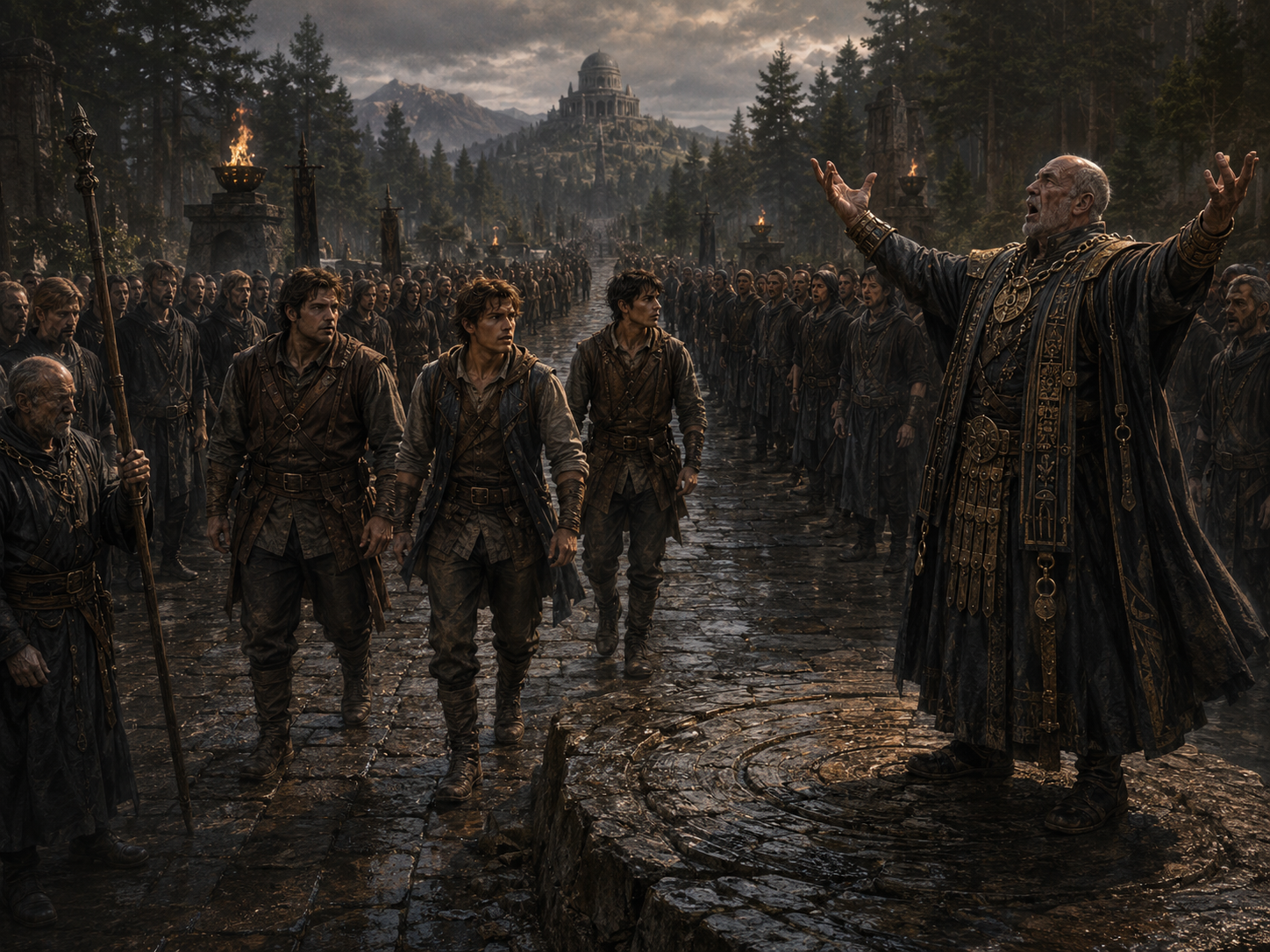
The sharp sounds made by the Magistrate’s staff caused the crowd to make way with surprising coordination and discipline, opening a wide, well-defined aisle that led across the platform towards a ramp that descended to the road beyond. In the process, an Ancestral Law Judge standing alone in full regalia was revealed. This official waited at the beginning of the road on a broad, well-worn, ancient-looking granite flagstone that had been set flush into the macadam like a marker. Rath thought that stone had to be a rootstone. He had come across the term once while doing research for a sociology composition. The Index had defined it as “a ritualistic origin point held in great reverence by the Monitor Nation, the beginning from which all life journeys are made.”
Ancient, bald, but noticeably physically robust with broad shoulders and large workman’s hands, the Judge had a clenched brow and a dark scowl; his expression was just the sort you would expect from an old man compelled to a disagreeable task. As soon as the way was clear, the Magistrate gestured with his staff to direct the three Custodian men forwards.
Both Fhaeyr and Aron shot quizzical glances at Rath, a clear indication that they expected that he would know what was going on. Even though he did not, he nodded, and the three of them advanced together. The Magistrate fell in behind, slowly tapping a pace with his staff as he walked. The rhythm of the taps had the inevitable, fatalistic beat of a funeral dirge.
Rath fell into step with the beat and Fhaeyr and Aron matched him. The Monitor Nation placed great value on adherence to tradition; Rath’s compliance here — even though he would have to guess his part — could only work in his favor.
His choice was correct; a low, raw, bass chant, a synchronized martial cadence in Theirs, began from the crowd. The chant had an uncommitted reluctance at first, but soon became more energetic as more and more voices joined until it almost thundered.
The Magistrate stopped at the top of the ramp, but his staff and the chant continued to mark the cadence. Rath led his companions down to face the Judge, and when the staff and the chant fell abruptly silent, he stopped, three paces short of the rootstone.
The Judge raised his arms skyward and made a hoarse declaration in Theirs. The observing Monitors replied with a three word shout and then all became still. Finally, after clearing his throat with a sound like tossing broken glass and nails down a waste chute, the Judge began his song. It was loud, surprisingly lyrical, and followed the same beat pattern as had the Magistrate. There were two verses and a repeated refrain. To Rath’s surprise, and in spite of the fact that he understood none of it, he found the composition heroic, uplifting, and emboldening.
At the end of the song, the Magistrate descended to stand just behind Rath. “This begins your first challenge, The Nine Bridges. This is a Test of Courage. You must advance along this road and reach the Observatory atop the mount at its end before the light of the Big Sun fades completely. If you turn back, fail to hold the road, or fail to cross each bridge, you will fail the challenge. This Test of Courage will determine the worthiness of the Challenger.”
“So this is The Ordeal,” Aron said to the Magistrate. “I didn’t know that it was still used. Does the traditional punishment apply to failure?”
“It does.”
“Ah.”
Fhaeyr frowned. “What’s the traditional punishment?”
“Humiliation,” the Magistrate declared.
“Crushed by having large stones piled on top of you,” Aron clarified. Then, unnecessarily, he added, “Until you stop breathing.”
The Magistrate tapped his staff five times. “Challenger and Shield Brethren must now depart!”
Straightaway, the Magistrate joined the Judge and the two Monitor officials moved aside to make the way clear.
Fhaeyr shot a glare at the Magistrate and the Judge, then asked Rath, “Run?”
“Yes, definitely. Run,” Rath confirmed. “Keep a twelve minute per kilometer pace, though.”
Aron gave a grunt as the three of them took off. “Uphill run. Not my strength.”
The pace that Rath set was one where they could cover distance at a good rate, but still had breath to speak. He reasoned that it would be better to conserve effort at the start; holding back something for a strong finish was his standard practice. As he settled into the familiar rhythm, he felt twinges in his knee that warned that a faster pace would not be easy for him. No matter. If it came to a sprint, he would sprint and suffer whatever physical consequence followed.
After a hundred meters or so, with the trees closing in towards the road and far enough so that he was certain that none of the Monitors behind them might catch his words, Rath asked, “I was caught, if you had not heard. Did either of you also get caught?”
His first supposition was that the two other young men had likewise been arrested and sent back. This would explain, at least if he did not nitpick the details, their delegation as his companions in this test. For that to work, he had to presume that the Monitor Nation had come up with some rationale under their customs or traditions that justified their return and had made that demand of the Custodian Nation.
“Not me,” Aron said right away. “When all the Larsarii — the Amazons — started searching the upper terraces, I was able to sneak down and hide in a big shrubbery. But I didn’t actually see anything.”
“I didn’t either,” Fhaeyr said in sync with his regulated breathing. “I didn’t get that close. But the Maidens don’t shed their robes until they are in the water. And they put them on before they come out. All those rumors about ‘frolicking’ are pure crap.”
“So you both made it back undetected? That blows my first theory.”
“Did you ask for us?” Fhaeyr asked, his tone even. He was not making an accusation.
“No. I’ve never mentioned your names.”
“I walked all the way back,” Aron said. “I spent a few days with some relatives on Section One, L40. I had planned that as my alibi all along. My family never suspected that I had tried The Stunt.”
“My story is like that,” Fhaeyr said, his sentences punctuated by his breathing. “My family’s been negotiating fairly intensely for my marriage. Working to arrange acquaintance meetings with the prospective spouses. I convinced my Grand Aunt to schedule all of them for the same day. The day after the Solstice. For efficiency. I got a ride on a bot on the way back and made a quick return trip. Had enough time to get a few hours’ rest, a meal, and a shower. Then ran the gauntlet the next day. Eight meetings in eight hours. Eight different sections. Three different levels.”
Aron chuckled. “Find a preferred candidate? Is she nice looking?”
Fhaeyr laughed, falling off the pace for a second. “No comment.”
“I didn’t have an alibi,” Rath admitted. No alibi could have withstood Grandmother’s scrutiny.
“Is this your punishment?” Aron asked.
“No, the Monitors sent me back after a show trial. The Elders Tribunal gave me Penance and unpaid labor for the Section, plus a dozen suspended punishments,” Rath said. “This is something else. It will take a while to explain.”
“Any idea how long this road is?” Fhaeyr asked. “Maybe we should pick up the pace to make it in time.”
“I don’t know,” Rath said.
“It’s ten kilometers,” Aron supplied.
“Good to know, but how did you learn that?” Rath asked.
“I’m pretty sure that this is a ritual site called the March of the Bold,” Aron replied. “The nine bridges along a single road match the description that I read. Archivists have access to information reported by The Supervisor in The Factory to The Index, and I have several Archivists in my sept. I’ve always been interested in Monitor culture and history, but after I got back home, I tried to find out everything I could. I did a lot of research.”
“What else do you know about this challenge?” Fhaeyr pressed. “We need to know as much as you do.”
“This isn’t just a timed race. It’s a contested advance against opposing forces. We have to break through our Nemesis to reach the end.”
“How many opponents?” Fhaeyr asked. “Armed?”
“Two to ten men, usually distributed along the route,” Aron supplied. “The number is at the discretion of the defenders. They can be barehanded or have armor and weapons. That depends on the Judge. They aren’t allowed to hide or ambush us. Tradition calls for them to defend the bridges — there’s a story in their history from First World about the heroic relief of a besieged city, nine bridges, and the rescue of a Queen — but they can also wait along the road. We can’t go off the road, even a single step, to avoid them.”
“That’s all the rules?” Fhaeyr asked. “Nothing else?”
Aron nodded. “Any special rules or conditions have to be announced at the start of the challenge. Since they stated none, there are none.”
Fhaeyr made a face. “Meaning our opponents have no limitations whatsoever.”
“That Judge didn’t look like he favored us,” Rath said. “They’ll be armed.”
“We’ll know soon,” Aron said. “The first bridge has to be over that rise up ahead. It’s just one and a half kilometers from the rootstone.”
Of necessity, Rath halted at the top of the rise and waved for Fhaeyr and Aron to do likewise. Where the road up to this point had been in full sun, the crown of the rise was swathed in deep shadow by encroaching live oaks. No more than one hundred meters further down a very slight slope, a rocky brook of several meters in width bisected the road. A broad clearing covered in tall grass, bramble, and thistle ran along the banks of the brook for about fifty meters in each direction. In contrast to the road surface, the bridge was old stonework, hand laid, with a flagstone deck. While the pavement was a consistent ten meters in width, the bridge was only five at best. Across the head of the bridge, between its meter-high parapets, the Nemesis awaited.
All of them.
The slight height advantage of their observation spot allowed Rath a clear view of the full length of the twenty-five-meter bridge.
The ten men wore the steel and leather combat armor of Shields, though identifying sigils and rank insignia were absent. Five of the men held one-meter by two-meter rectangular greatshields whose slightly bowed faces were entirely black. These were grounded on the flagstones and edge to edge spanned the entire width of the bridge with not a single gap. Behind, the other five men held three-meter-length spears with half-meter blades at their tips. These projected over the shields, angled slightly down. The defenders had clearly seen Rath, Fhaeyr, and Aron arrive and were braced and ready.
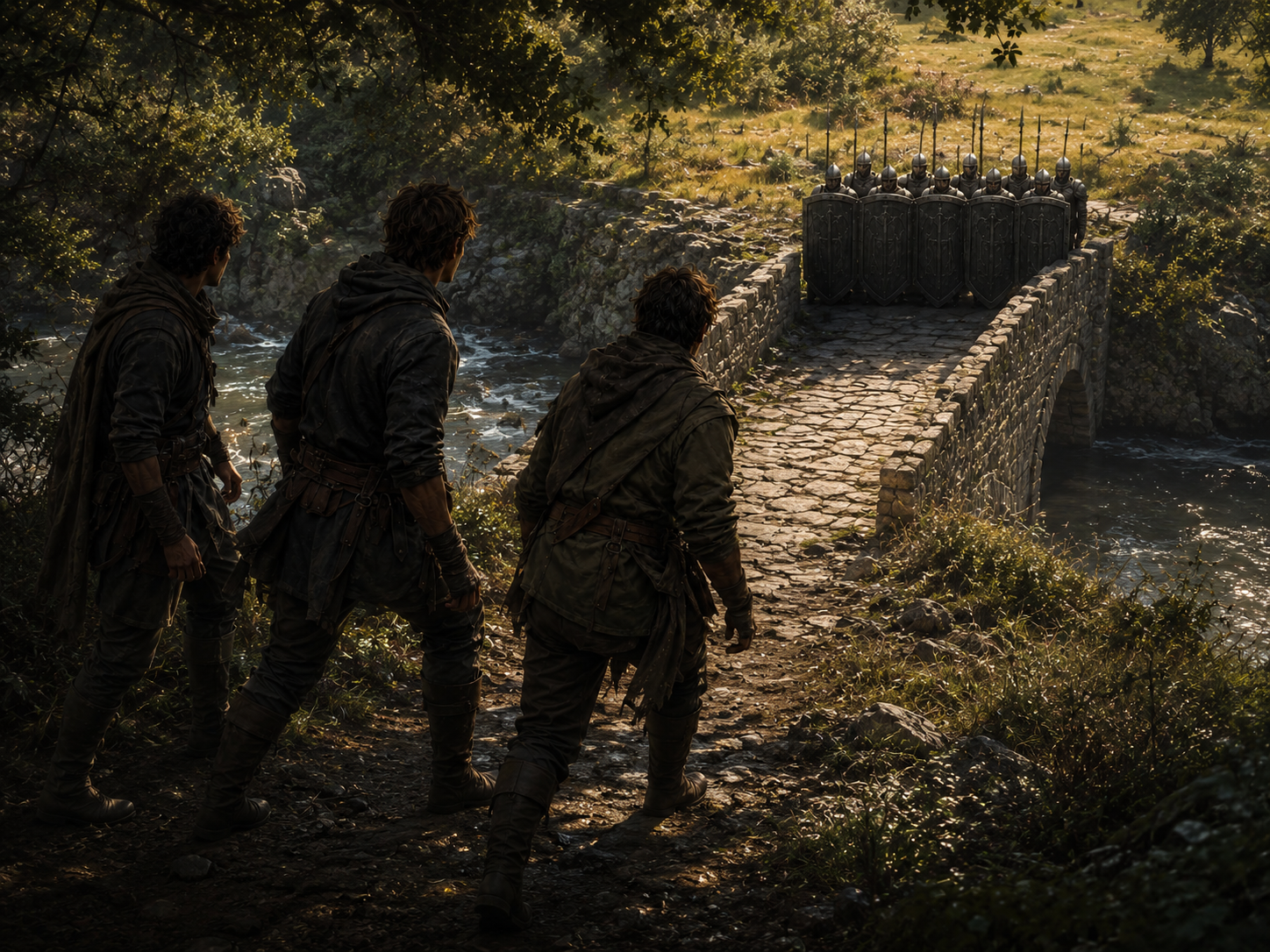
“We’re not going to be allowed to succeed,” Fhaeyr said.
“They didn’t want us to cross even a single bridge,” Aron agreed. “They’ve put everything here.”
“It’s a static defense,” Rath said. “They’re not coming out after us. Those heavy shields and the spears would be useless in a skirmish.”
“They don’t think that we’ll try to break the shield wall,” Fhaeyr said. “And that’s what I would think too, if I were them. It’d take ten or twenty times our number to charge that position and even at that we’d leave a lot of ours on the ground. They expect to wait us out until the Big Sun goes down.”
Rath thought furiously for a few moments. “The only resource that we have is our mobility.”
“We can’t go around the bridge,” Aron reminded pointedly.
“Right. We have to go through the wall and across the bridge. Once we clear the far end of the bridge, it will be a footrace with no one in front of us. That armor and their weapons will slow them down, even if they leave the shields and the spears, and they’ll have to stop to dump the armor. If we give it everything we’ve got for the next kilometer, we’ll pull so far ahead of them that they won’t be able to catch up. Then it’s just a steady slog to the end.”
Fhaeyr frowned. “Sounds great, except for the ‘go through the wall’ bit. Without that, none of the rest of it matters.”
Aron nodded. “I like your plan, Rath, but Fhaeyr is right.”
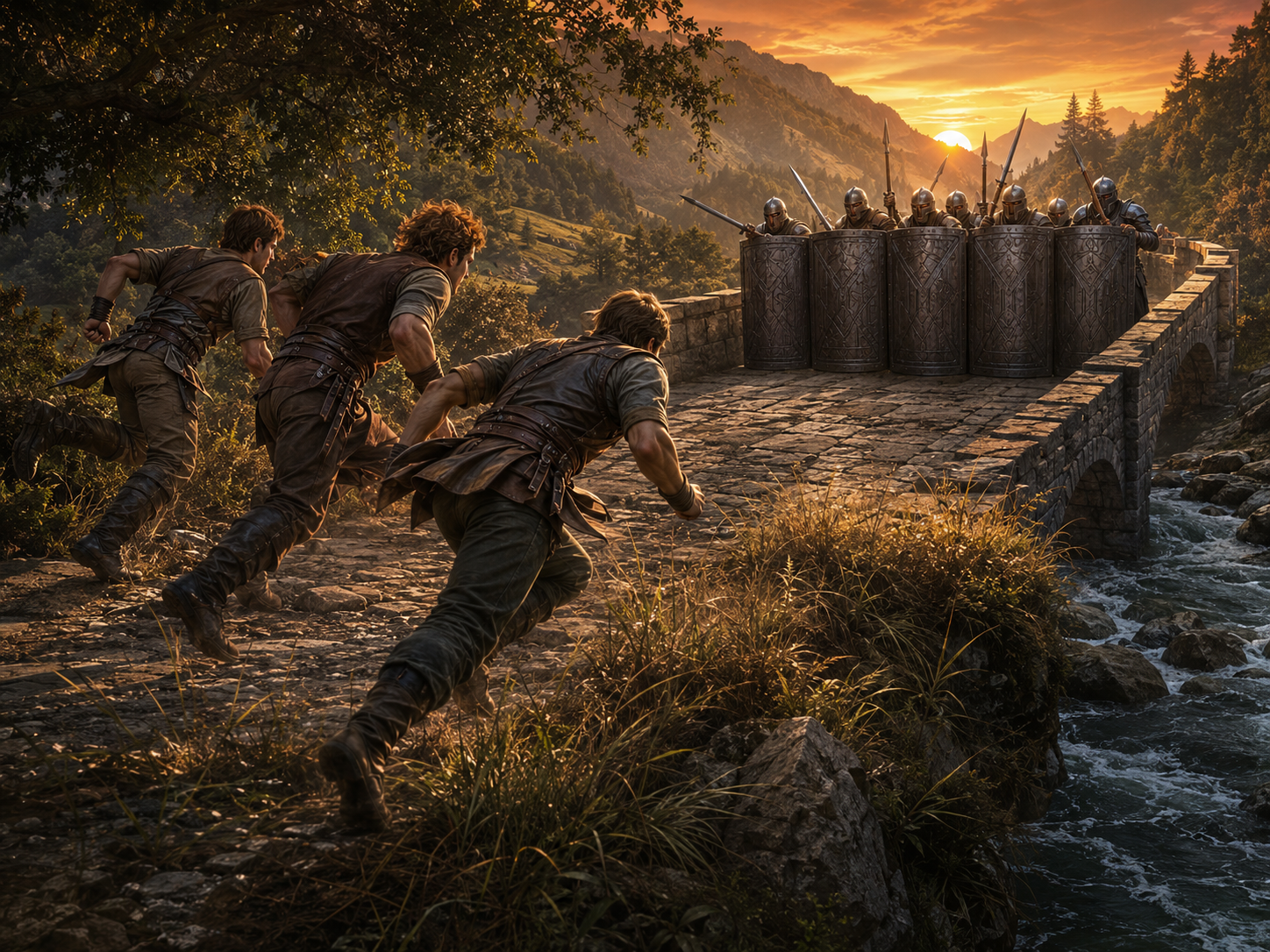
“We don’t have to break through five shields and ten men, just one shield and one man. Their shields aren’t interlaced or overlapped so they don’t support each other. The bulk and height of those shields make them awkward and maybe top-heavy. If I hit one hard enough and fast enough with all my weight at the right point, it might go over backwards, pinning that man underneath. Like you said, they don’t expect that and that will make them unprepared for it. With both of you right behind me, we’ll charge through the hole and keep going.”
“Those long spears won’t pivot quickly,” Fhaeyr mused. “If you did manage to punch a hole, we might actually have a split second or two while they drop the spears and draw swords to sprint through.”
“That might be feasible,” Aron admitted. “With the spears blocked by the shields, they can’t be depressed enough to ward the entire wall. You’d have to keep your head down, Rath, or lose it.”
“Are we agreed, then?” Rath asked.
“The only alternative that I can think of is to take to the forest and try to evade the Monitors until we get back across The River,” Aron offered. “That might be doable — if that’s something you could do, Rath — but the odds are probably about the same.”
“If we made it back, we’d have to go into exile,” Fhaeyr said, shaking his head. “The Elders would have to send us away to appease the Monitors.”
“I’ll take that as a yes,” Rath said. “Aron?”
“I’m with you, Rath, wherever you lead.”
“Agree,” Fhaeyr said, “but I should be the vanguard. I weigh a good five kilos more than you, Rath. More mass means more force.”
“I’m faster than you.”
“Not proven.”
“I swear on the honor —”
Fhaeyr quickly waved his hands in surrender. “No oath necessary. I’ll take your word for it.”
“Right,” Rath said. “We should get started.”
What he had not told the others was that he intended to use his Talent Wfythurgthyr at the moment of impact to drive through the shield and the man behind it. The Monitors had not bound his Talents with an oath, as Mhagtyr had said they did with The Trek, and had not made a rule against the use of magic. Their own rules, if only because they had neglected to make such a provision, allowed this.
He could not simply fly to the mount, with the other two men hanging onto his back; he was certain that the Monitors would consider that abandonment of the road and, also, he would have to reveal his Talent to Fhaeyr and Aron as well as the entire Monitor Nation. For as long as he could, he wanted to keep his magic concealed from his companions. He could easily see where his curse could erode their friendship, if not destroy it completely.
At a second or two before impact, in the midst of a leap, he would fly instantly at his maximum speed. The Monitor holding the shield, no matter how strong or how big, would not be able to stand against him.
Or, at least, that was how he hoped it would be.
Comments